

How To Install Eddie Bauer Car Seat Rear Facing
Rear-Facing Car Seats for Infants & Toddlers
Folio Content
The AAP recommends that all infants ride rear facing starting with their get-go ride home from the infirmary. All infants and toddlers should ride in a rear-facing seat as long every bit possible until they accomplish the highest weight or height allowed by their auto safety seat manufacturer. Virtually convertible seats have limits that will allow children to ride rear facing for 2 years or more than. When infants outgrow their rear-facing–merely seat, a convertible seat installed rear facing is needed. All parents can do good from getting installation assist from a CPST to ensure that their child's seat is properly installed.
Types of Rear-Facing Seats:
3 types of rear-facing seats are bachelor: rear-facing–only, convertible, and all-in-one. When children reach the highest weight or length allowed by the manufacturer of their rear-facing–only seat, they should continue to ride rear facing in a convertible or all-in-one seat.
Rear-facing–only seats
- Are used for infants up to 22 to 35 pounds, depending on the model.
- Are small and have carrying handles.
- Commonly come with a base of operations that can be left in the car. The seat clicks into and out of the base so y'all don't have to install the seat each fourth dimension you use it. Parents can purchase more one base for boosted vehicles.
- Should exist used only for a child's travel (not sleeping, feeding, or any other employ exterior the vehicle).
Convertible seats (used rear facing)
- Can be used rear facing and, later, "converted" to forward facing for older children when they outgrow either the weight limit or the length limit for rear facing. This ways the seat tin exist used longer by your child. Convertible seats are bulkier than infant seats, all the same, and they do not come with conveying handles or separate bases and are designed to stay in the car.
- Many have higher limits in rear-facing weight (up to 40–50 pounds) and superlative than those of rear-facing– only seats, a feature that makes convertible seats ideal for bigger babies and toddlers.
- Have a five-indicate harness that attaches at the shoulders, at the hips, and between the legs.
- Should be used only for a kid's travel (not sleeping, feeding, or whatever other use outside the vehicle).
All-in-i seats (used rear facing)
- Tin can be used rear facing, forward facing, or as a belt- positioning booster. This means the seat may be used longer by your child as your kid grows.
- Are often bigger in size, so it is important to check that they fit in the vehicle while they are rear facing.
- Do not have the convenience of a carrying handle or separate base; however, they may have higher limits in rear-facing weight (upwards to forty–50 pounds) and height than those of rear-facing–only seats, a feature that makes all-in-one seats ideal for bigger babies and toddlers.
Installation Tips for Rear-Facing Seats:
Always read the vehicle owner's transmission and the auto safety seat manual earlier installing the seat.
When using a rear-facing seat, go along the following tips in mind:
- Place the harnesses in your rear-facing seat in slots that are at or below your kid's shoulders.
- Ensure that the harness is snug (y'all cannot pinch any slack betwixt your fingers when testing the harness straps over the kid's shoulders) and that the retainer clip is placed at the center of the chest, fifty-fifty with your child's armpits.
- Make certain the machine rubber seat is installed tightly in the vehicle with either lower anchors or a locked seat belt. Many motorcar safety seats have an integrated lock-off to continue the seat belt locked. If your seat has one, follow the manufacturer's recommendations on how to use information technology. If you tin move the seat at the belt path more than an inch side to side or front to back, it's not tight plenty.
- Never place a rear-facing seat in the front seat of a vehicle that has an agile forepart rider airbag. If the airbag inflates, information technology volition hit the back of the automobile safety seat, right against your child'south head, and could cause serious injury or death.
- If you are using a convertible or all-in-ane seat in the rear-facing position, make sure the seat belt or lower anchor webbing is routed through the correct belt path. Cheque the instructions that came with the motorcar safety seat to be certain.
- Make certain the seat is at the correct angle so your child's head does not flop frontwards. Check the instructions to detect out the correct angle for your seat and how to arrange the angle if needed. All rear-facing seats have congenital-in recline indicators.
- Check the car safety seat instructions and vehicle owner'due south manual nigh whether the car safety seat may contact the back of the vehicle seat in front end of it.
- Still having trouble? Bank check with a certified CPST in your area who can help. See If You Need Installation Help on page 16 for information on how to locate a CPST.
Common Questions:
What if my kid's anxiety touch the back of the vehicle seat?
- This is a very common concern of parents, but information technology should crusade them no worry. Children are very flexible and can e'er easily find a comfortable position in a rear-facing seat. Injuries to the legs are very rare for children facing the rear.
What do I do if my child slouches down or to the side in the car seat?
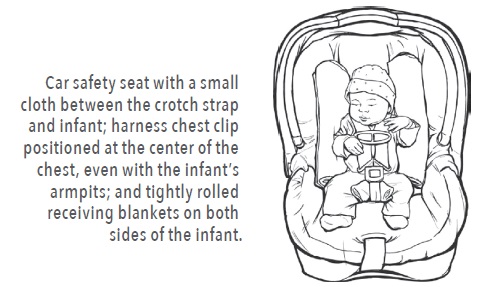
- You can attempt placing a tightly rolled receiving blanket on both sides of your child. Many manufacturers allow the utilize of a tightly rolled small diaper or material between the crotch strap and your child, if necessary, to prevent slouching. Do not identify padding under or backside your child or use any sort of car prophylactic seat insert unless information technology came with the seat or was fabricated by the manufacturer for utilise with that specific seat.
Why should I dress my child in thinner layers of vesture before strapping him or her into a car safety seat?
- Bulky clothing, including winter coats and snowsuits, can shrink in a crash and get out the straps too loose to restrain your child, leading to increased risk of injury. Ideally, apparel your baby in thinner layers and wrap a coat or coating around your infant over the buckled harness straps if needed. Run across Winter Car Seat Safe Tips from the AAP.
Do preemies need a special machine seat?
A machine condom seat should be canonical for a baby'southward weight. Very small babies who can sit safely in a semi-reclined position ordinarily fit better in rear-facing–only seats. Babies born preterm should be screened while still in the hospital to make certain they can sit safely in a semi-reclined position. Babies who need to lie flat during travel may be able to ride in a auto bed that meets Federal Motor Vehicle Safety Standard 213. They should be screened again while in the hospital to make sure they tin lie safely in the car bed.
Additional Data from HealthyChildren.org:
-
Heading Out With Baby
-
Shopping for Car Seats: Tips for Parents
-
Auto Seats: Product Listing
Figure 1 from Balderdash MJ, Engle WA; American Academy of Pediatrics Committee on Injury, Violence, and Poison Prevention, Commission on Fetus and Newborn. Safe transportation of preterm and low birth weight infants at hospital discharge. Pediatrics. 2009;123(5);1424–1429.
Commodity Torso
- Last Updated
- ii/28/2021
- Source
- Adapted from Car Safety Seats Guide (Copyright © 2022 American Academy of Pediatrics)
The information contained on this Web site should not be used as a substitute for the medical care and advice of your pediatrician. There may be variations in treatment that your pediatrician may recommend based on individual facts and circumstances.

Source: https://healthychildren.org/English/safety-prevention/on-the-go/Pages/Rear-Facing-Car-Seats-for-Infants-Toddlers.aspx
Posted by: freemanarche1959.blogspot.com
0 Response to "How To Install Eddie Bauer Car Seat Rear Facing"
Post a Comment