

What Do You Do If The Water Well Casing Repair Fails?
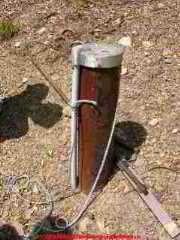 Water Well Casing Leak Symptoms, Diagnosis, Repairs
- Post a QUESTION or Annotate about how to observe, notice, and repair leaks in h2o well casings
InspectAPedia tolerates no conflicts of interest. Nosotros have no relationship with advertisers, products, or services discussed at this website.
Water well casing leak diagnosis & repair:
This article describes the diagnosis and repair of leaky water well casings. Leaks into a well casing risk contaminating the well water with unsanitary ground water, surface runoff, and salts, fertilizer, bacteria, or any other contaminant likely to be flowing on the ground surface.
If the water well is an artesian well, the leak case described hither, a different problem occurs: the continuous release of well h2o, under pressure, into the surrounding soils, risking expanse flooding, erosion, wasting of potable h2o, and possible damage to the underlying aquifer.
We also provide an Commodity INDEX for this topic, or yous tin try the page height or lesser SEARCH BOX as a quick way to find data you need.
Well Casing Leaks: diagnosis & repair of leaks in residential water well casings
 Here we will depict the following: causes & furnishings of well pipage leaks, diagnosis, effects, remedy; definition of well casing; How to Repair a Leaky Well Casing: choose between drilling a new well or installing i or more well casing repair sleeves. Using a Repair Sleeve to Fix a Leak in Steel Well Casings for H2o Wells. Drilled Well Annular-Space Leaks Around the Well Casing
Article Contents
- WELL CASING LEAK REPAIRS
- WELL CASING LEAK REPAIR METHODS choose between drilling a new well or installing one or more well casing repair sleeves
- WELL CASING REPAIR SLEEVES to fix a leak in steel well casings for h2o wells
- WELL CASING ANNULAR SPACE LEAKS around the casing of a drilled well
[Click to overstate whatever image]
Definition of well casing: what's a "Well Casing" anyway?
A well casing is a steel pipage that is used to seal and back up the sides of a drilled water well. The diameter of a residential water well casing is 4", 5", or 6" merely much larger steel casings are used in other water wells. A photograph of the to a higher place-footing portion of the well casing is shown in the photograph at the pinnacle of this page.
While soil and well designs vary as ground, soil, stone and water availability too vary in different areas, generally, after the well has been drilled the casing is driven into the drilled opening in the earth to a dept that (commonly) inserts the bottom of the casing in bedrock. The drilled well depth continues downwards into bedrock, through which water flows into the well.
A grout is then pumped around the steel casing to seal the casing bottom and sides against water leakage into the well.
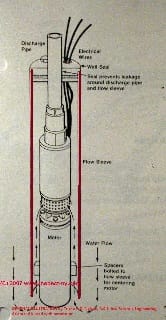
The well casing is shown in cross department, represented by the two vertical red lines in our cartoon at left. But of class really the well casing is a round steel pipe.
Our sketch at left crams more parts into a pocket-sized space than you'd find in a real water well - we've got the submersible pump up there near the pinnacle of the well casing; really the pump will be located a few feet or more off of the well bottom, and really in virtually water wells the steel casing extends from the ground surface down into bedrock merely the well bore itself continues down through that stone to a deeper depth - the casing does not extend to the very bottom of the well. - Ed.
How does water become from the well, up the casing, and into the building?
When the well construction is nearly complete, a hole is cut in the side of the well casing near footing level (beneath the frost line in freezing climates). The water piping that picks up water from the well near its bottom is routed up the center of the well casing until it reaches that exit opening in the casing side. There the pipage (and the h2o it carries) exits the well casing through a pitless adapter (a fitting that seals the hole in the casing), continuing on to bring water to the building the well is serving.
See H2o PUMPS, TANKS, DIAGNOSTICS for farther explanation of well pumps and water storage tanks or pressure tanks and their controls.
See WELL CAPS & COVERS for well casing cap sealing and venting requirements
How to Repair a Leaky Well Casing: choose between drilling a new well or installing one or more well casing repair sleeves

Leaks in steel water well casings can be acquired by a variety of troubles including corrosion, pressure level from stones or other objects outside the casing, splits at a welded or lacking casing seam, fifty-fifty a lightning strike, and nearby structure that includes diggings.
The shallow well at our New York laboratory produced clear potable water from 1920 to the 1990s when the town of Poughkeepsie decided to re-route the highway virtually our holding. Nearby rock blasting was followed by the sudden and persistent advent of silt in our drinking water.
The photo (left) of a roughly 2" x iii" hole in a well casing is provided courtesy of Link-Piping, a no-dig well casing and h2o master repair / well-rehabilitation visitor[two]. Link-Piping's literature calls this well casing hole corrosion damage only we think the edges of the pigsty and that protruding rock sure arrive look as if the casing side was broken through by pressure of the stones and earth or other pressures outside the well.
 It can exist difficult to know that your well casing pipe has developed a leak. But common symptoms that lead to an investigation of the condition of the casing (possibly requiring a CCTV camera) include
- Sudden appearance of dirt, sand, debris in the water supply
- A reduction in well flow rate
- A new bacterial or other contamination problem in the well water. Leaks into a well casing take a chance conveying surface or groundwater contaminants into the water delivered past the well.
Leaks in the well casing are a problem because of the gamble of leaks of surface contaminants into the well.
Our 2d image (left) shows the side of the aforementioned well casing after Link-Pipe'southward well casing sleeve has been installed.
Well casing repair sleeves are suitable for repairing damage to a well casing that permits leaks into or out of the well casing.
Using a Repair Sleeve to Fix a Leak in Steel Well Casings for Water Wells
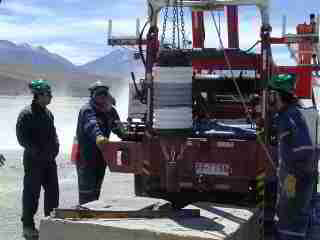 Presuming that the surface water or groundwater leak into a well is not occurring correct at the pitless adapter that carries well pipage out through the side of the casing (that's high plenty to be repaired by excavation down to it outside the well casing itself), there are indeed repair sleeves designed to fit within of a wide range of well casing diameters.
Repair sleeves for well casings may use different repair approaches (resin-sealed to the old casing or dry "Filter-Sleeve" a patented alternative used by Link-Piping, a no-dig well casing and h2o principal repair / well-rehabilitation company[2] ( Tel: 800-265-5696 ).
The casing repair sleeve is inserted with monitoring past a CCTV to be sure that it'southward properly located. [Images & tech review requested half-dozen/27/12, Image at above-left courtesy Link-Pipage]
Repair sleeves are designed to fix a specific leak spot in a well casing - often one that occurs nigh the elevation of the water level where oxygen and water combine to increase the gamble of corrosion.
The installer lowers a well casing repair sleeve, a cylinder small enough to slide into the casing, to the point where the casing is leaking, and then using i of several methods, seals the sleeve to the surrounding well casing to block the casing leak or damage.
Typical well casing repair sleeve lengths run from six inches to 3 feet.
The sleeve associates is lowered into the well to the depth of the leak problem and and then affixed in place. Depending on the sleeve type the internal diameter of the well volition be reduced past about an inch or inch and a quarter.
This should still leave sufficient space to be able to pull and restore the well pump, foot valve, etc. If not, you're in trouble.
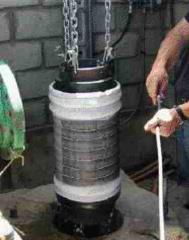 The photograph at left (courtesy Link-Pipe) shows the filter sleeve assembly along with a CCTV monitoring camera beingness lowered into a well.
Depression force per unit area pipe repair sleeves are used in both wells and water mains, result in a reduction in well casing bore of about i 1/iv inches, and employ a resin-soaked gasket around the sleeve exterior surface to seal the contact space between the repair sleeve and the original well casing.[two]
For petroleum wells and peradventure water wells, " Pressure activated sealants take been used on numerous occasions to repair casing leaks with the tubing in identify. A major reward in utilizing this applied science is that the sealant will only solidify where the leak is active. In add-on, the material is easily removed by mechanical means and will not add difficulty to hereafter piece of work over operations if required." [1]
For injection wells the petroleum/gas industry has developed ultra fine cements that are used in a slurry class as well as other injectable sealants like Injectrol to seal well casings, merely with varying success. [3]
High pressure dry-type well casing repair sleeves use air or h2o to expand the sleeve to seal the well casing once it'due south in place. The sleeve has to exist securely locked in place earlier the installation is concluded, lest it sideslip down and expose the leak it's trying to seal.
This approach depends on fine suspended solids in the water supply to somewhen clog and thus seal the sleeve against the original well casing and tin can easily seal a 2" to 3" hole in the well casing. [2]
A well casing repair sleeve does not line the entire well casing - it'd exist style likewise costly.
Investigate These Questions Before Using a Well Casing Repair Sleeve
Earlier launching a well casing repair sleeve project, an assessment of the condition of the entire well casing is in society as well as a determination of why the leak has occurred - the leak source. For case, if a casing is leaking because it's splitting forth a welded seam, or if large sections of the casing are badly corroded, we may be pessimistic about the future of other casing sections and a repair sleeve arroyo may make no sense.
I take read that it tin can exist difficult to accurately locate some casing leaks, and in the petroleum industry very sophisticated (and expensive) methods are required that are merely not going to be practical nor affordable for a residential water well.
If a well casing has multiple leaks, is splitting, or is desperately corroded I'd question the economics and feasibility of the repair sleeve approach.
Unfortunately it'southward probably new-well time for most homeowners at that point - we don't detect many residential water well drillers pulling the entire casing to replace information technology, though that may be done in the petroleum manufacture[1]. Besides I would heed to the advice of an experienced local well driller in deciding how to repair the well. And if no one in the area has experience installing a well repair sleeve, that option may be out of the question anyway.
Finally, in deciding on the repair versus replace question for a residential water well, one would consider the performance of the current well as well as its historic period and casing condition. If the well is marginal or modest, that may argue confronting a plush repair.
On the other manus, as corrosion in a well casing may be local to the usual meridian of the static caput in the well, the repair sleeve approach may make sense
Drilled Well Annular-Space Leaks Around the Well Casing
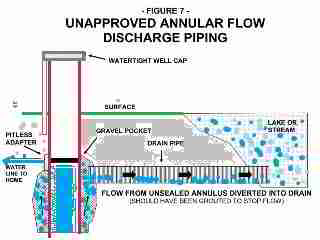 Leaks Around the Well Casing Rather than Through It
A different well water leak, failure to seal the annular space effectually the well casing outside, risks contamination of conventional drilled wells as surface and ground water leak downwards into the aquifer around the casing.
Analogy adapted from: Michigan DEP Flowing Well Handbook [8]
And an annular space leak around an artesian well sends water to the surface, eroding soils, flooding lands, wasting water, and causing other trouble. Discussing leaks effectually the exterior of the casing of an artesian well, the Michigan DEP points out,
Sealing the annular space surrounding the well casing is critical, since an ineffective seal or absence of a seal can consequence in the uncontrolled belch of water on the outside of the well casing pipe.
When ground water breaks out on the outside of the well casing, erosion of the confining geologic layer and other overlying materials can occur. The uncontrolled discharge of ground water from flowing wells tin cause flooding of the well site and side by side properties and damage to nearby structures.[8]
Michigan and other states regulate the construction of artesian wells to require that the well is constructed so every bit to
- foreclose unnecessary discharge of water from the aquifer to the ground or ground surface
- protect the aquifer against contamination
- protect confronting erosion and confine the water menstruum to within the well casing
Details about artesian wells and leaks around the well casing rather than through information technology are provided
at ARTESIAN WELLS, Well Spools
Reader Question: how can I fix a leaky residential water well casing?
Our water pump in the well recently went out and nosotros hired a crew to replace the pump. However I am concerned if he used right process and if caused more than problems than we started with.
When he first strated pulling up the drop pipe the "spool" was stuck and he had problems with pulling information technology up at first, once it came gratuitous he set it back downwardly and took the cablevision off.
So he came up to the house and told me he is going to cascade some acid downwardly to soak over dark and loosen up the "spool" so he could pull it up, he dumped nearly 2 gallons of it down at that place and the next day he pulled everything up again.
After when he started blasting out the black water a bunch of sand came out and he told u.s.a. we need an entirely new well because at that place is a hole in the case, and sleeving the case wasn't an option.
Notwithstanding later on he left I was looking at the pipes and wire left that was pulled upwards and they have some bad corrosion just higher up the water level. I am wondering if the acrid he poured down the casing ate through the casing where it sat overnight and caused the hole? Also there was no sand to be plant in the quondam pump which makes me more suspicious.
Is this acid treatment normal and safe for the casing? Is he telling me the truth that no 1 ever "sleeves" the case and that its non an option?
Cheers ahead of time for whatever information well-nigh this, I am non fabricated of money and tin can't afford to be taken reward of. Thanks again - B.T. 4/25/12
Answer: role of well spools & using well casing repair sleeves to repair well casing leaks at residential h2o wells
Details almost finding and fixing well casing leaks are
at WELL CASING LEAK REPAIRS.
Excerpts are just beneath.
A competent onsite inspection by an expert usually finds additional clues that help accurately diagnose a problem, and I'k non at all sure I take a full picture of what's going on with your well.
That said, here are some things to consider about well spools, leaks in the well casing, and using acid to free up a stuck well spool in your well.:
OPINION: when y'all are non comfortable with advice yous've received ("you need a new well") start by asking your well driller to explain his reasoning. Near contractors are quite honest and are not out to gouge yous, but they were not English majors and may non exist expert in communication.
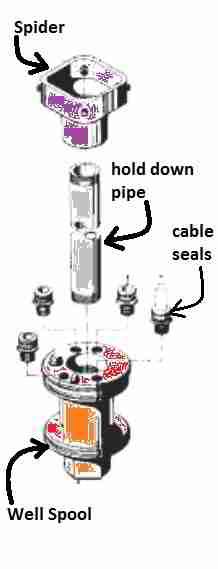
A well spool is a special seal around the well pipage used to seal a well casing in wells at which the static head of water level in the well casing rises in a higher place the frost level. Basically it's a "spool-shaped" plumbing fitting that incorporates round flanges at its top and bottom, threaded to accept well pipe fittings above and below the spool.
Well spools are required on artesian wells or "flowing wells" in freezing climates.[8] Without this component the upper well casing could be split up past freezing water.
Our illustration of a well spool at left, edited from a schematic provided by Baker Manufacturing[7] illustrates the part of this associates.
The well spool is held in position by a hold-down spider to keep the spool from being pushed up in the casing by the pressure of water ascension in the well casing, and O-rings seal the well spool to the well casing itself. .[seven] - Ed. [Permission & tech review requested 6/27/12]
Details about artesian wells and well spools are at ARTESIAN WELLS, Well Spools
Fixing a leaky well casing - re-drill versus well casing repair sleeves
Leaks in the well casing are a trouble because of the risk of leaks of surface contaminants into the well.
Repair sleeves for well casings may use different repair approaches (resin-sealed to the quondam casing or dry out "Filter-Sleeve" a patented alternative used past Link-Pipe, a no-dig well casing and water master repair / well-rehabilitation company[2] ( Tel: 800-265-5696 ).
The casing repair sleeve is inserted with monitoring past a CCTV to exist certain that information technology's properly located. [Images & tech review requested six/27/12]
Repair sleeves are designed to fix a specific leak spot in a well casing - often i that occurs near the elevation of the h2o level where oxygen and water combine to increase the risk of corrosion.
The installer lowers a well casing repair sleeve, a cylinder pocket-sized enough to slide into the casing, to the point where the casing is leaking, and so using one of several methods, seals the sleeve to the surrounding well casing to block the casing leak or damage.
Typical well casing repair sleeve lengths run from six inches to three feet. The sleeve assembly is lowered into the well to the depth of the leak problem and so affixed in place.
Depending on the sleeve type the internal bore of the well will be reduced by about an inch or inch and a quarter
. This should still get out sufficient space to be able to pull and restore the well pump, human foot valve, etc. If not, yous're in trouble.
Finally, in deciding on the repair versus replace question for a residential h2o well, i would consider the performance of the electric current well equally well as its age and casing condition. If the well is marginal or modest, that may argue against a costly repair.
On the other hand, every bit corrosion in a well casing may be local to the usual top of the static caput in the well, the repair sleeve approach may make sense. Like you I'grand nervous nigh pouring acid or any potentially toxic chemic into a well.
Reader Q&A - likewise see the FAQs series linked-to below
Goodman
Thank yous for an interesting question. The color of well h2o the changes when at that place'south rain is nigh likely because the red is either leaking some surface contaminants into the well or changing the level of the water table to feed the well in part from a different water source..
Yous might inquire your local Water Testing Lab to test a water sample for fe, tannins, and for coming surface sourced contaminants such as nitrates and of course coliform.
Why should the colour of the water change Everytime it rains.
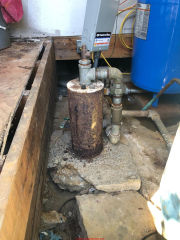 Mike:
Mike:
More on causes of a rising well casing causes for a well pipe to rise out of the ground
Ane wonders
how deep is the casing itself,
how old is the well installation
could h2o or expanding clay be pushing up soil under the physical poured around the casing and could the concrete be so bonded to the steel well casing that it in plow lifted the casing
Is this well within of the principal building or in an outbuilding?
Accept in that location been leaks or has there been water entry around the well? It looks like that might be the example: the casing is quite rusted most the conrcete and the soil nether the physical around the casing looks wet.
Lookout out: the lifting well casing risks:
1. loss of sanitary seal on the exterior of the casing, a potential case of water contamination
2. lifting nearby pipe connections causing a leak that could flood the area
For other readers: this appears to exist an unusual situation: either the well casing itself is beingness pushed upwards or something connected to the casing is lifting it upwards.
That well casing upwards move can happen, depending on local climate (not all of these pertain to Mike'southward well casing)
due to things we've listed so far, only the cause of Mike's rising wall casing may be different
- expansive dirt soils
- an unexpected artesian well h2o supply force per unit area increase that fills the casing and pushes it upwards
- frost boost of surrounding building materials or piping connected to the casing - shouldn't happen if runoff and groundwater are kept away
- something else we've not discovered
- Ice lensing uplift of a well casing - shouldn't happen if the casing is well sealed against surrounding groundwater
Here [photo to a higher place] is a picture show, mostly sandy loam, some clay 4-5 ft downwardly, merely I wouldn't call information technology expansive. Local well guy has non seen anything like it. Anyway here is a pic.
Is in that location expansive clay soil?
,
No just a standard steel casing well, water at well-nigh 40 ft. The steel casing has some rust on it, but its lifting the physical upwards around the casing.
Artesian well?
,
Nope never freezes here its come up about two inches cracking the physical, so strange.
thanks for the reply
well casing ascension upward out of ground
Mike
Is your well in a freezing climate?
Water ice lensing can push a casing up out of the ground in some instances.
We explicate water ice lensing or "frost lensing" at FOUNDATION DAMAGE by Water ice LENSING
Expansive clay soils or an artesian well could also push a casing upwards from its original installation position.
Accept you ever seen well casings offset raising up? what causes this?
I need to know where I can purchase a water well casing repair sleeve
Where can I purchase a water well casing repair sleeve
Water is coming upwards exterior the casing.you tin can hear it within the casing
Amy
Accept a look at the soil surface gradient or grading around the well; if there is a depression effectually the casing that might explain water collection there.
Information technology is too possible that some wells can be flooded by local rainwater, either entering from the aquifer ( normal) or entering the well casing from a leaky well casing side or top.
if the latter is going on, such a well may temporarily act like an artesian well, sending water up and out nearly the casing top or at a leaky pitless adapter if your casing uses i of those below footing.
Your plumber or well service visitor may desire to open the well casing and inspect the entire casing for damage using a well bore photographic camera.
Allow me know what you're told and nosotros tin can accept information technology from at that place.
For air discharge at fixtures in that location are several explanations.
See details at AIR DISCHARGE at FAUCETS, FIXTURES https://www.inspectapedia.com/water/Air_Discharge_at_Faucet.php
Certainly if in that location are leaks into the well casing from holes, rust, splits, bad piping connections etc. and so the well water may non be germ-free.
We take water standing around the well head but we accept also had an abnormally amount of rain. The water is not standing in any other location of the yard which is concerning. Sometimes when using the water in the house we get a little air in the pipe. Is this normal for a well?
Reader Question: can we replace a damaged casing ourselves?
can we fix it ourself if not how much will it cost we put everything new on it but a well and a casing how do you put a casin on do you put a new wraping around information technology or what i dont have 2500dallors what do i need to do who practice i need to telephone call. - Christine Hobbs 8/16/xi
Reply:
Replacing a well casing is non something a homeowner has the equipment nor knowledge to do - if that'southward what's needed.
But well casing that is damaged close to the top of the ground, say past a crack, might be "repaired" by a homeowner who dug to that point, cleaned the surface, and tried a patching expoxy. A pro might use welding instead. I'm non sure what "put everything new on information technology" means. I suggest getting a detailed trouble diagnosis and repair gauge from a plumber or well driller in your area. Allow the states know what you're told.
...
Keep reading at WELL PIPING LEAK DIAGNOSIS or select a topic from the closely-related manufactures below, or see the consummate ARTICLE INDEX.
Or see WELL CASING LEAK REPAIR FAQs - questions & answers posted originally at this article
Or see these
Well Contamiantion, Debris, or Cleaning & Repair Manufactures
- WELL Bore CAMERA SYSTEMS
- WELL CAPS & COVERS
- WELL Structure & MAINTENANCE
- Water PRESSURE Trouble DIAGNOSIS Tabular array
- WELL CASING LEAK REPAIRS - a cracked or rusted well casing can be a source of well contamination, mud, h2o loss.
- WELL CHLORINATION & DISINFECTION if the cleaning your well needs is to address bacterial contamination
- WELL FLOW Rate
- WELL PIPING LEAK DIAGNOSIS - leaks out can also suck debris into water pipe
- WELL WATER Force per unit area DIAGNOSIS for other reasons (besides clogged well screens or clogged filters) that can explicate poor water pressure or flow.
- WELL RETRIEVAL TOOLS - fish out stuff dropped into a well
- WELL Water Contagion: CAUSES, CURES - home
Suggested citation for this web folio
WELL CASING LEAK REPAIRS at InspectApedia.com - online encyclopedia of building & environmental inspection, testing, diagnosis, repair, & trouble prevention advice.
Or encounter this
INDEX to RELATED Manufactures: ARTICLE Alphabetize to WATER SUPPLY, PUMPS TANKS WELLS
Or utilise the SEARCH BOX found beneath to Ask a Question or Search InspectApedia
...
Ask a Question or Search InspectApedia
Endeavor the search box just below, or if you prefer, post a question or comment in the Comments box below and nosotros will respond promptly.
Search the InspectApedia website
Notation: appearance of your Comment below may be delayed: if your comment contains an prototype, web link, or text that looks to the software equally if information technology might be a spider web link, your posting will announced subsequently it has been approved past a moderator. Apologies for the delay.
Technical Reviewers & References
Click to Show or Hide Citations & References
Publisher InspectApedia.com - Daniel Friedman

What Do You Do If The Water Well Casing Repair Fails?,
Source: https://inspectapedia.com/water/Well_Casing_Leaks.php
Posted by: freemanarche1959.blogspot.com
0 Response to "What Do You Do If The Water Well Casing Repair Fails?"
Post a Comment