

How To Repair A Haws Water Fountain Spout Vidio
Complimentary Webinar | Wednesday, April 27, 2022 | 10:00 am-eleven:00 am PDT
ADA & Drinking Fountain Compliance: All You Demand To Know
During this one-hour webinar, we volition walk you through the important dimensional requirements to consider when designing a building or installing/retrofitting all types of hydration equipment, as well every bit bottle filling station requirements and how to include them in your overall ADA-compliance program.
Register At present

Boosted Resources
ANSI / ISEA Z358.1 Resource Heart
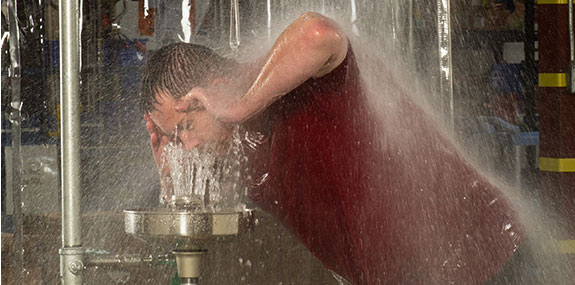
Today, simply providing emergency eyewash and shower products is non plenty. Facilities must inspect, exam, and monitor emergency equipment system readiness and performance. Each unit must be accessible, usable, and tepid-water equipped.
Larn More
Resource
Gratuitous Onsite ANSI Z358.i Survey
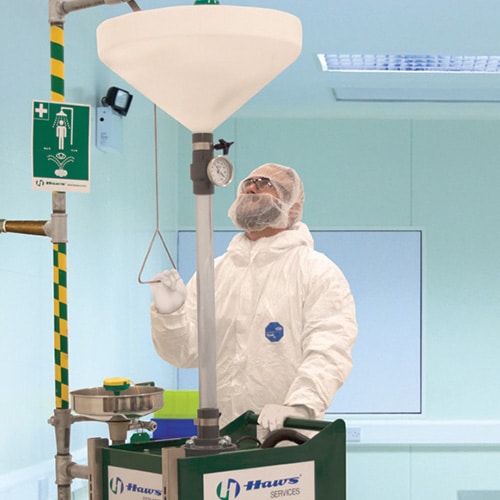
Past taking advantage of Haws' ANSI Emergency Shower and Eye/Face up Wash Survey Program, you volition be able to aid ensure your facility non only meets the most recent ANSI Z358.1 Standards, simply also provides proper functionality and advisable showtime assist capabilities in the event of an emergency.
Learn More

Resources
Technical Downloads
Scan all of our technical documents including Spec Sheets, AutoCAD, 3D Revit, MasterSpec and more.
Scan At present
Haws Spec Tools: helping you lot find the right fit for your project.
MasterSpec
Visit our MasterSpec® folio.
View NowCADdetails
Visit our CADdetails® page.
View NowBIMobject
Visit our BIMobject® folio.
View NowEarn Your CEUs
Request a Lunch & Larn
If you are an AIA, ASPE, ABIH, or IFMA member, these presentations offering Continuing Education units (CEUs) for both face-to-face and online sessions.
Learn More

White Papers, Instance Studies, Videos & More
Reference Materials
Browse and filter through all of our reference materials with our easy to utilize filtered search.
Browse Now

Codes & Certifications
The Americans with Disabilities Act (ADA)
Commonly referred to every bit ADA or ADAAG, it requires direction to provide accessibility and usability for the physically handicapped. Composed of five sections referred to as "titles", the most important are Titles Ii and III.
Interpretations of the Deed are made by the Architectural and Transportation Barriers Compliance Lath. They are enforced by the Department of Justice, and the Federal court organisation has final say.
Championship II
Requires all programs, services and activities of regime entities be accessible by qualified disabled persons.
Title Iii
Imposes different duties on two classes of buildings:
- Public accommodations.
- Commercial facilities.
Haws articles products to enable the owner to comply with ADAAG.
ADA Drinking Fountain and ADA H2o Cooler Information
4.15 Drinking Fountains and Water Coolers.
four.15.1 Minimum Number.Drinking fountains or water coolers required to exist accessible by 4.1 shall comply with 4.xv.
iv.xv.2* Spout Summit. Spouts shall be no higher than 36 in (915 mm), measured from the flooring or footing surfaces to the spout outlet.
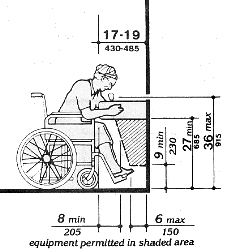
Spout Tiptop and Knee Clearance. The front end edge of the fountain must extend 17 to 19 inches (430 - 485 mm) from the wall. The 27 inches (685 mm) loftier minimum clear knee space must be free of equipment or obstructions for a minimum of 8 inches (205 mm) extending from the front edge of the fountain back toward the wall. In addition, a minimum 9 inches (230 mm) high toe clearance infinite must exist provided extending back toward the wall to a distance no more than than six inches (150 mm) from the dorsum wall. The toe clearance space must be costless of equipment or obstructions.
iv.15.iii Spout Location. The spouts of drinking fountains and h2o coolers shall exist at the forepart of the unit of measurement and shall straight the water catamenia in a trajectory that is parallel or about parallel to the front of the unit of measurement. The spout shall provide a flow of h2o at least 4 in (100 mm) high so as to permit the insertion of a cup or glass under the catamenia of h2o. On an accessible drinking fountain with a circular or oval basin, the spout must be positioned so the menstruation of water is within three in (75 mm) of the front edge of the fountain.
4.15.four Controls.Controls shall comply with iv.27.iv. Unit of measurement controls shall be front mounted or side mounted near the front border.
4.15.5 Clearances.
(ane) Wall- and mail-mounted cantilevered units shall have a clear knee space between the bottom of the apron and the floor or footing at least 27 in (685 mm) loftier, thirty in (760 mm) wide, and 17 in to 19 in (430 mm to 485 mm) deep. Such units shall also have a minimum clear floor space thirty in by 48 in (760 mm by 1220 mm) to allow a person in a wheelchair to arroyo the unit of measurement facing forward.
Spout Acme and Articulatio genus Clearance. The front end edge of the fountain must extend 17 to nineteen inches (430 - 485 mm) from the wall. The 27 inches (685 mm) high minimum articulate knee space must be free of equipment or obstructions for a minimum of 8 inches (205 mm) extending from the front end edge of the fountain back toward the wall. In improver, a minimum 9 inches (230 mm) high toe clearance space must be provided extending back toward the wall to a distance no more 6 inches (150 mm) from the back wall. The toe clearance infinite must be free of equipment or obstructions.
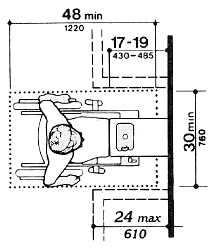
Articulate Floor Space. A 48 inch (1220 mm) minimum by 30 inch (760 mm) minimum clear floor space is required for a forward approach to a wall-mounted fountain. If the wall-mounted fountain is in an alcove, the minimum width of the alcove is 30 inches (760 mm) and the depth is 24 inches (610 mm) maximum.
(2) Gratuitous-continuing or born units not having a clear space under them shall have a clear floor infinite at to the lowest degree xxx in by 48 in (760 mm past 1220 mm) that allows a person in a wheelchair to brand a parallel approach to the unit. This articulate floor space shall comply with 4.two.four.
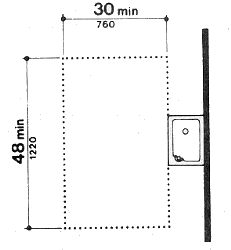
Free-Standing Fountain or Cooler. A 48 inch (1220 mm) minimum by 30 inch (760 mm) minimum articulate floor space is required for a side approach (long side parallel to the front of the fountain or cooler).
Article By: Kelly Gilfoy
Haws Representative
Some have commented that emergency shower & eyewash equipment has no "accessible" dimensional requirements, because this type of equipment is not mentioned in the A.D.A. Accessibility Guidelines. Some accept gone so far as to condone the accessibility of this equipment entirely. I feel that this misconception could be the result of a fundamental misunderstanding of the A.D.A.
If the A.D.A. and the A.D.A. Accessibility Guidelines were just another plumbing or building code, then I would agree that we need non pursue anything that is not specifically required of united states of america in impress. However, the A.D.A. is non a plumbing lawmaking. It is a civil rights law, which prohibits any form of discrimination against people with physical disabilities.
The A.D.A. states that "No individual shall exist discriminated confronting on the basis of inability in the full and equal enjoyment of the appurtenances, services, facilities, privileges, advantages, or accommodations of any place of public accommodation", (Sec.36.201, General Requirements.) So to deny a disabled person free and unfettered access to anything within a facility, that is freely available to whatsoever non-disabled person, is a violation of that disabled person's civil rights. Equal rights in this instance means equal admission.
ADAAG Department 4.3.i, Accessible Buildings: New Construction, Paragraph (18), requires that "If fixed or congenital-in seating or tables (including, simply not limited to, study carrels and educatee laboratory stations), are provided in accessible public or common employ areas, at least five percent (5%), just not less than one, of the fixed or built-in seating areas or tables shall comply with 4.32." Then in Section 4.1.5 "Building Additions", and again in Department iv.1.6 "Building Alterations", the ADAAG requires that these building modifications conform to the rules prescribed in Department 4.3.1 for New Construction, (to a higher place). Finally, in Section A4.1.1(3) "Piece of work Areas Used by Employees" the ADAAG elaborates on Section iv.1.three by adding that "Where there are individual work stations (e.g., laboratories, service counters, ticket booths), 5%, merely not less than ane, of each type of piece of work station should be constructed and then that an individual with disabilities can maneuver within the work stations." So we can run across that the A.D.A. states that all laboratories, public and individual, new construction and remodel, must have provision to exist accessible to and usable by the disabled.
If the disabled cannot exist denied access to the laboratory to employ the lab equipment at an accessible workstation, and thereby be exposed to the chemical hazards present, then would the Courtroom detect that the disabled person's civil rights would be violated for denying him access to the simply lifesaving emergency shower and eyewash in that laboratory room? Would the Courtroom rule in favor of the disabled if they were considering the issue after a laboratory accident, and subsequent injury of a disabled person?
The State of California seems to call up that they would, considering California'due south D.S.A. Policy 98-03 at present requires a disabled accessible shower and eyewash in every laboratory classroom, for all school modernization or new construction projects, which receive land funding.
Now the dimensional requirements that would make emergency shower and eyewash accessible are also clearly defined in the ADAAG Standards, in the course of general dimensional requirements for the wheelchair, and for the wheelchair user's infinite requirements.
Section 4.2 "Space Allowance and Reach Ranges" covers the minimum floor space, the width of approach, and the maximum forwards achieve and side reach ranges. Although, while 4.2.four.1 calls for a 30" wide (minimum) arroyo for the wheelchair, Department A4.2.ane states that "if the wheelchair must be turned at the opening or if 'sudden' movements are needed and so a clear width of 32" is adequate clearance." The 32" wide approach allows for a slightly larger margin of condom, so a 32" minimum should be used for all design considerations wherever emergency equipment, life prophylactic and emergency egress is an issue.
Sections 4.2.five, and 4.ii.6, covers the forward and side reach ranges of the wheelchair user, and you tin can see in Effigy 5(b) "Maximum Forrad Attain Over an Obstruction", that if the eyewash were to exist 20" long or less, that the pull rod handle would have to be 48" above the floor (or less), but that if the eyewash were longer than xx", and so the pull rod handle could be no college than 44" higher up the flooring.
Additional maximum and minimum dimensional information are also shown in Figure A3, and Figure A3(a), including the standard 27" minimum knee clearance.
Wall mounted "Protruding Objects" (like eyewashes), and objects that hang down into the "Caput Room" space (like shower heads), are covered in Section iv.four.
"Gratings", if they are used for emergency shower flooring drainage, are covered in Department 4.five.4.
"Controls and Operating Mechanisms", their maximum and minimum heights for control location, and the strength required to consequence the operation of any device, are covered in Section 4.27.
The laboratory piece of work stations, as noted in Section 4.1.three, paragraph (18), are required to meet Department four.32. And when we look in that department we detect the same 27" high knee clearance that we take seen repeated throughout the ADAAG. The counter tops though are allowed to be between 28" and 34" in meridian, which affects all counter mounted eyewashes. However, given a 5" to 7" deep sink, where ledge-mounted pivoting eyewashes would typically exist used, and allowing for the 27" loftier knee clearance, the counter tops could not be lower than 32".
Information technology is important to notation that ANSI Z358.ane, Department 5.iv.1 allows for the eyewash spray heads to exist as low equally 33", even for the non-disabled person, so when we consider all of these dimensional ranges we tin see that they allow for a single shower & eyewash that tin serve either the able bodied or the disabled.ane
Since at that place is typically only one emergency shower and eyewash per laboratory room or laboratory classroom, and since 1 attainable device tin serve either the able bodied or the disabled, specifying that it be disabled attainable will assistance to protect the health and prophylactic of the disabled and the able bodied, while protecting the liability exposure of the specifier, and the property owner.
All of the ADA, and the ADAAG Sections referenced in this letter are printed out for your reference on the ensuing pages, forth with their related figures and diagrams.
___________________
one The apply of some types of emergency eyewash that are recessed into the counter top, would require that the counter be no lower than 32", regardless of whether a sink is used or not.
American National Standards Institute (ANSI)
ANSI has served in its capacity every bit ambassador and coordinator of the The states private sector voluntary standardization system for 80 years. Founded in 1918, the Institute is a private, nonprofit membership organization supported by a diverse constituency of private and public sector organizations.
ANSI Z358.1 - 2022 Emergency Eyewash and Shower Equipment
- Established detailed minimum performance requirements.
- Intended to provide uniform minimum requirements for equipment functioning, installation, test procedures, maintenance and training.
- CSA has certified that Haws Emergency Equipment products meet ANSI Z358.i - 2022.
ANSI Z535.one - 1991
- Safety color lawmaking for mark physical hazards.
- All-time feasible colour bigotry for observers of both normal and color-scarce vision.
- Decrease in personal injuries every bit great as xl% has followed the use of a uniform colour program.
Condom Green
Color for the identification of safety, emergency egress, location of first aid and safety equipment.
Safety Yellow
Colour for the identification of caution, physical hazard, containers, corrosives, etc.
Haws emergency equipment products are congenital to comply with the ANSI Standard Z358.1 for Emergency Equipment and related products and the ANSI Standard Z535.1 for Rubber color.
ANSI A117.1 - 1992
- This standard provides for accessibility and usability for physically handicapped people.
- More than extensive, descriptive, comprehensive and understandable than the current ADA guidelines.
- Contains operational and dimensional criteria.
Haws articles products to enable the owner to comply with ANSI A117.1-1992.
Annex G establishes an evaluation procedure for utilise when a 0.25% lead content requirement needs to exist met in addition to electric current chemical extraction requirements of the standard.
This annex was developed for the purpose of demonstrating conformance with California's Health & rubber Lawmaking (Section 116875; ordinarily referred to every bit AB1953) and that of other states and jurisdictions with a similar requirement.
Temperature Actuated Mixing Valves For Plumbed Emergency Equipment that should include the following redundant safety features.
- A stay-open cold h2o supply upon hot h2o failure
- Accurate control of the hot water (when merely the eyewash is in employ
- Total catamenia cold water past-pass in the event of blocked flows (Source)
Canadian Standards Association (CSA) International
Established in 1919, CSA International is a well-recognized, independent leader in standards evolution and the application of these standards through certification of both product and in-house testing of the production.
- CSA certifies manufacturing plants to conduct testing and certify products on their behalf.
- CSA is also accountant for NSF certification of Haws Drinking Fountains to NSF Standard 61, Section 9.
The Haws plant is CSA-certified.
AB1953 is encompassed in the California Assembly Bill 1953, enacted in September 2006, which calls for a reduction in pb content in all fitting including pipes, fittings and fixtures to a level less than 0.25%. This law goes into result on the first day of January 2010 and all the same products sold and installed on and later on that appointment must meet this AB1953 pb reduction requirements.
The good news: Haws has been AB1953 compliant since 1990.
Haws has always been committed to providing the safest drinking water possible. When California passed proffer 65 in 1987, Haws made the decision to manufacture all drinking fountain products using a peculiarly blended lead-gratuitous brass alloy. By the get-go of the 1990s, the entire Haws drinking fountain production line had been converted to the new lead-free alloys, and was entirely 0.0% lead-costless.
All of Haws' drinking fountain products have carried the NSF/ANSI 61, Section ix, certification since the early 1990s. Haws NSF/ANSI 61 certifications, obtained through the internationally recognized CSA Testing Laboratory, for all of its drinking fountains, faucets and electric water libation product lines are available online.
To assure the public of Haws' compliance with the new California law, Haws has also obtained independent third party verification of compliance with AB1953, through the CSA Testing Laboratory.
Further, in club to meet future requirements Haws has introduced drinking h2o products with a 100% pb costless waterway, Haws' two new all stainless steel drinking faucets, models 5010SS and 5010.6427SS, and the new all stainless steel pushbutton valve model 5874SS accept also been certified to NSF/ANSI 61 by CSA Testing Laboratories. Look for future new drinking fountain products that incorporate these faucets for a fully certified solution.
You may have seen the following warning associated with our products, as well every bit on other products purchased from other manufacturers:
Alarm: This product contains chemicals known to the Land of California to cause cancer, nascency defects or other reproductive harm.
This alarm is the event of a law passed in California in 1986, referred to as the California Safe Drinking H2o and Toxic Enforcement Human activity of 1986, or more more often than not referred to as "Proposition 65."
There are over 900 chemicals on the Prop 65 list. Our products take traces of various chemicals that are on the list, but all are part of the normal manufacturing process. Further, the chemicals are within our product materials.
The warning does not hateful that our products will necessarily cause cancer or reproductive harm. Moreover, a Suggestion 65 warning does not hateful a product is in violation of any production-rubber standards or requirements. More information from the State of California. Haws will continuously review the requirements of Proposition 65 to ensure that it only is included on products that require the warning.
What is Proposition 65?
Proposition 65 requires the Land to publish a list of chemicals known to cause cancer or nativity defects or other reproductive harm. This list has grown to include approximately 900 chemicals. The list includes a wide variety of chemicals that can be found in many everyday items. The purpose of Proposition 65 is to ensure that people are informed about the potential exposure to these chemicals.
A warning must be given if the listed chemical is just nowadays in a production unless a business demonstrates that the exposure it causes poses "no significant adventure." With respect to carcinogens, the "no significant risk" level is defined as the level which is calculated to result in not more than ane excess example of cancer in 100,000 individuals exposed over a 70-year lifetime.
What does this warning mean?
This warning does not necessarily mean that our products volition crusade cancer or reproductive harm nor does it mean our product is in violation of any Federal or Land product-condom standards or requirements. Yous could retrieve of Proposition 65 more as a 'right to know' law than a pure product safety law.
Why does the Haws Corporation include this warning?
Proposition 65 police applies to any company that operates in California, manufactures or sells products in California. Since our products are sold throughout the earth, it would be extremely difficult and costly to decide which products are only brought into California. Therefore, at this time, to ensure compliance with the Proposition 65 law, we accept decided to include this warning on all of our products, regardless of destination.
ISO is a nonprofit, worldwide federation of national standard organizations that provides the development of standardization to improve international exchange of goods and services. The basic goal is to provide condolement in consistency and uniformity of goods or service at all levels of supply concatenation.
ISO 9000
Not a set or product standards, but a procedure for quality direction and quality assurance.
Conformance Standards
ISO 9001
Denotes a quality systems model for quality balls in design, development, production, installation and servicing. Certifies the visitor, not the production.
ISO 9002
Denotes a quality systems model for quality assurance in product and installation just.
ISO 9003
A quality systems model for quality balls in concluding inspections and testing.
Guidance Standard
ISO 9004
Haws is an ISO 9001 certified company.
National Sanitary Foundation International (NSF)
Founded in 1944, NSF International is a not-for-profit, noncommercial organization known for their function in developing standards, product testing and certification services in the areas of public wellness prophylactic and the protection of the environment. NSF conducts research and tests and evaluates equipment, products and services for compliance with standards and criteria.
Three Standards for Additive Products
ANSI/NSF Standard 60 Drinking Water Chemicals-Health Effects
Covers water treatment chemicals.
ANSI/NSF Standard 61 Drinking Water System Components-Health Effects
Covers indirect additives.
ANSI/NSF Standard 61, Section 9
Covers devices used in the last level of h2o distribution. Limits the amount of lead or other contaminants that may exist contributed by those devices to the drinking water.
Haws articles drinking fountains, electric water coolers and electric drinking fountains to be lead costless past all known definitions including ANSI/NSF Standard 61, Section ix, California Suggestion 65 and the Federal Safety Drinking Water Act.
- Both federal and state acts.
- Not written to production or performance specification.
- Apply ANSI Z358.1-1998 for guidance on compliance.
The Safe Drinking Water Act (SDWA)
Beginning passed in 1974 and reauthorized in 1996, this Deed establishes a process which selects and regulates contaminants posing the greatest public health run a risk.
SDWA compliance requires:
- Annual public report on contaminants.
- Source-water projection.
- Operator certification.
- Radon/arsenic regulation.
Underwriters Laboratories (UL)
Underwriters Laboratories, Inc., (UL) is an contained, not-for-profit production safety testing and certification system. Chartered every bit a non-turn a profit organization to establish, maintain and operate laboratories for the test and testing of devices, systems and materials.
Haws Electric Water Cooler and Electric Drinking Fountain products are UL-listed.
Client Support
Do yous want to speak to a representative?
Contact Us

How To Repair A Haws Water Fountain Spout Vidio,
Source: https://www.hawsco.com/resources/
Posted by: freemanarche1959.blogspot.com
0 Response to "How To Repair A Haws Water Fountain Spout Vidio"
Post a Comment